

Screen Time Transition
(Oh S%*t!)
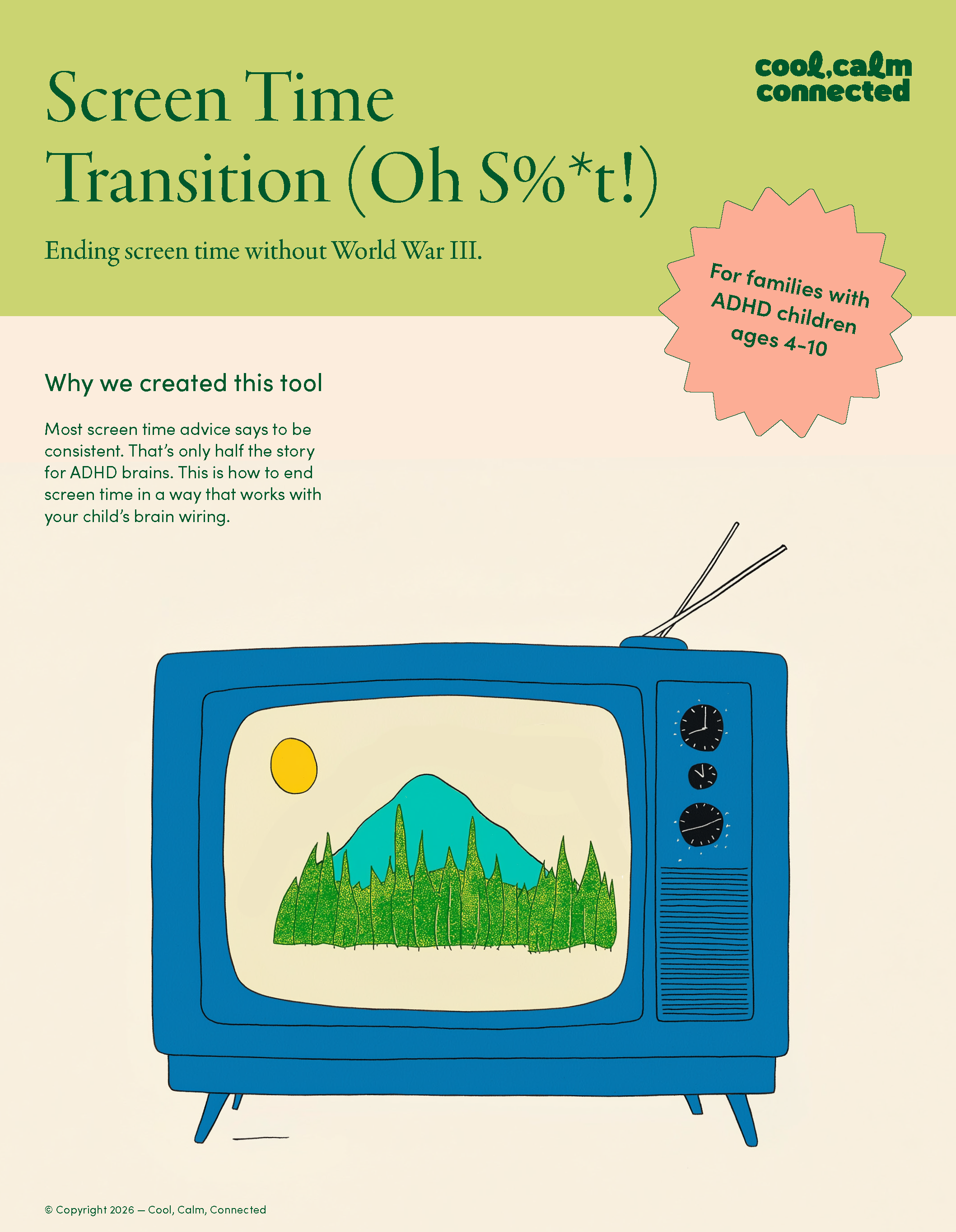
Ending screen time without World War III.
$19
For families with children ages 4–10
Self-paced online guide
Instant PDF download
Reviewed by a licensed clinical psychologist (PsyD) specializing in neurodivergent youth and families.
The problem we solve
Every screen ending was a fight. We started dreading the timer.
Ending screen time is neurologically hard for ADHD kids. Hyperfocus is real, and a five-minute warning does almost nothing to a brain that's fully locked in. Consistency matters, but it's only half the story. You also need a system built for how your child's brain actually exits.
Who it's for
Families with children ages 4–10 who struggle with screen transitions. Particularly those navigating ADHD, where hyperfocus, time blindness, and dopamine drops make screen endings genuinely harder than they look from the outside.
(Oh S%*t!)
✳︎
(Oh S%*t!)
✳︎
(Oh S%*t!) ✳︎ (Oh S%*t!) ✳︎

Why we made this
When screens end, ADHD brains don't just feel disappointed. They experience a chemical drop. Dopamine — which screens provide in steady supply — suddenly gone.
Add hyperfocus (your child may literally not have heard the timer). Time blindness (30 minutes felt like five). Transition difficulty (any task switch is hard; a high-stimulation one is harder). That's an accurate picture of why this is so difficult every single day.
The resistance is brain wiring. Knowing that doesn't make the meltdown easier in the moment. But it changes how you set the whole thing up.
This toolkit gives you a complete system built around that reality. Not just instructions to be more consistent.
The first two weeks will be rough. Worth saying upfront.
What you get
A self-paced online guide — available immediately after purchase, work through it at your own pace.
One PDF download, printable at home on any standard printer.
✔ Clinically reviewed.
How you use it
Start with the Beginner section — the timer, one warning, and having something ready when screens go off. Most of what matters is there.
The rest is there when you need to go deeper or troubleshoot.
Worth knowing
This toolkit pairs well with Reward Systems (ok, it's bribery) — turning off the screen earns a token. External motivation keeps the system working in month three, when the novelty of the protocol alone has worn off.
What's included
Beginner
The 5-step protocol you can use tonight
Scripts for the pushbacks
Intermediate
The complete system: the full protocol with each step's specific job, and why screen endings are so hard neurologically
Meltdown prevention strategies
Replacement activity cards
Natural consequences: how to use them alongside the protocol, not instead of it
Your own regulation: staying steady when they can't
Advanced
Customization by age: 4–7, 8–12
The Screen Time Contract: for older kids, agreements made during calm that become the reference point during battle
Customization by ADHD presentation
Troubleshooting
A realistic timeline: weeks 1–2, month 2, month 3 onwards