

Calm Corner
(you can use it too)
Because a pillow and a feelings poster aren't a strategy.
$26
For families with children ages 3–10
Self-paced online guide
Instant PDF download
Reviewed by a licensed clinical psychologist (PsyD) specializing in neurodivergent youth and families.
The problem we solve
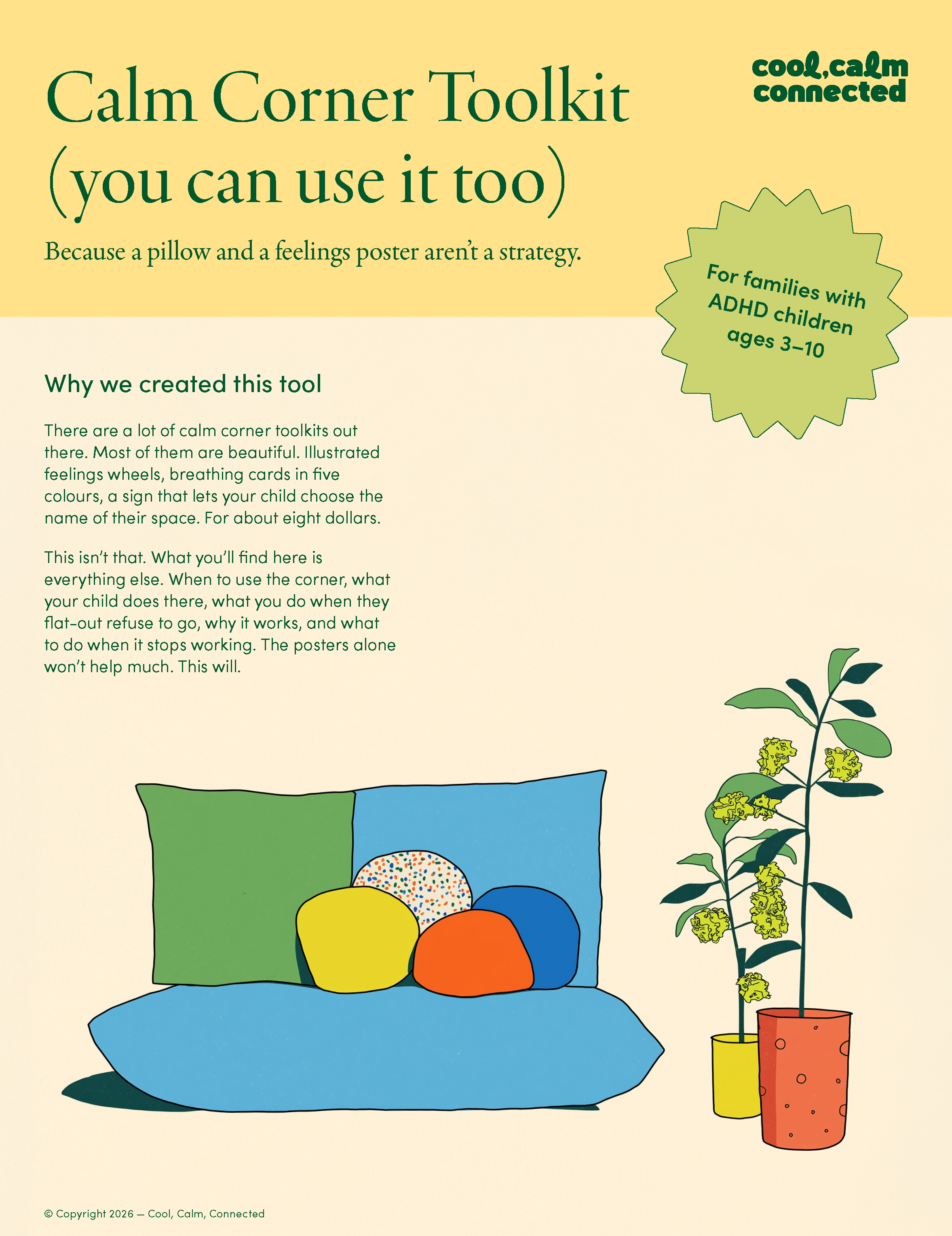
Most of them are beautiful. Illustrated feelings wheels, breathing cards in five colours, a sign that lets your child choose the name of their space.
This isn’t that. What you’re actually buying is everything else. When to use the corner, what your child does there, what you do when they flat-out refuse to go, why it works, and what to do when it stops working. The posters alone won’t help much. This will.
Who it's for
Families with children ages 3–10 navigating big emotions, ADHD, anxiety, or autism. Parents who've set up the Pinterest version, watched their child refuse to go near it, and want to understand why — and what to do instead.
You
✳︎
can
✳︎
use
✳︎
it
✳︎
too
✳︎
You ✳︎ can ✳︎ use ✳︎ it ✳︎ too ✳︎

Why we made this
I set up a calm corner for my son, and it looked right. The sign, the breathing cards, and the cozy blanket in a corner of the living room. He wouldn't go near it. The problem was that I'd introduced it during a meltdown. He'd already decided it was timeout with a cushion, and once that association was set, it was very hard to undo.
What I learned: the setup isn't the hard part. The framing is. The timing is. Going in there with him is. Those aren't instinctive — I had to figure out the language, the level to catch him at, and how to co-regulate when I wasn't exactly calm myself. This toolkit is everything I worked out the hard way, so you don't have to.
What you get
A self-paced online guide — available immediately after purchase, work through it at your own pace.
One PDF download, printable at home on any standard printer.
✔ Clinically reviewed.
How you use it
Start with the Beginner section and set it up this weekend. Use the introduction script during a calm moment — not during a meltdown, not right after one.
The rest is there when you need it: when a sibling disrupts it, when your child starts refusing, when novelty wears off, when you're ready to understand what's actually happening underneath.
If it stops working, the troubleshooting section is there.
Worth knowing
This toolkit pairs well with Reward Systems (ok, it's bribery). Using a calm corner strategy when escalating can earn a token — external motivation scaffolds the skill while the internal kind is still developing. The Advanced section of the Reward Systems toolkit covers exactly how to connect them.
What's included
Beginner
Complete setup guide
The one rule that determines whether this works or becomes timeout with a cushion
How the four components work together: visual supports, sensory input, calming activities, and co-regulation
Scripts for every moment
Intermediate
Why calm corners stop working
The neuroscience in plain language
Customization by brain type: ADHD, anxiety, autism, and mixed presentations
Age-appropriate expectations: 3-12 years
The four-week breathing practice plan
Troubleshooting
Advanced
Multi-sensory setup: visual, auditory, tactile, proprioceptive, olfactory
The four-phase progression toward genuine independence
Building interoception: helping your child notice their own body signals
When to seek professional support
Working with your child's school team
Printables
8 calm corner sign options — let your child choose which one
8 breathing exercise cards with visual guides
Feelings Scale
Feelings Wheel
Sensory Strategy Menu
Things I Can / Can't Control poster